
Agrimony Tea vs Capsules: Why the Milligrams Do Not Compare Directly
Agrimony tea vs capsules looks like a simple comparison until you read the amounts. A tea label may list grams of cut herb. A capsule may contain ground powder, dry extract, or an amount expressed as herb equivalent. These numbers describe different materials, so placing them side by side can create a false comparison.
HerbEra starts this comparison by identifying what each number measures. Milligrams without a material type, plant part, and serving definition provide limited information.
What is the short answer?
You cannot compare agrimony tea and capsules by milligrams alone. First identify whether the number refers to loose dried herb, powdered herb, dry extract, or an equivalent amount of starting herb.
Tea begins with plant material that is infused in water. The solids are normally removed before the drink is consumed. A powder capsule contains ground plant material. An extract capsule contains material produced after an extraction and drying process. Herb equivalent is a calculated or declared reference to the starting botanical material, not necessarily the physical weight inside the capsule.
| Material type | What the milligrams usually measure | What happens to the plant material | Can it be compared directly? |
|---|---|---|---|
| Loose agrimony herb | Weight of cut or fragmented dry plant material before brewing | Infused in water and usually filtered out | Only with another comparable loose-herb product |
| Agrimony tea bag | Total dry material in the bag | Infused and removed with the bag | Only after checking whether the bag contains pure agrimony or a blend |
| Agrimony powder capsule | Weight of ground botanical material inside the serving | The powder remains in the capsule | Only with another powder using the same species and plant part |
| Agrimony dry extract capsule | Weight of the dried extract, sometimes including or excluding carriers according to the label convention | The starting herb was extracted, filtered, and dried | Only after checking the extraction ratio and extract definition |
| Herb-equivalent statement | Declared quantity of starting herb represented by an extract | The physical capsule contains a smaller amount of extract plus any declared excipients | Not as if it were the actual fill weight |
What does a tea label measure?
An agrimony tea label normally states the weight of dried herbal substance used before infusion. This may appear in grams per tea bag, grams per serving, or directions for measuring loose herb.
The European Medicines Agency describes herbal tea as one or more herbal substances prepared with water by infusion, decoction, or maceration. Its agrimony monograph identifies herbal tea made from comminuted Agrimonia eupatoria herbal substance as a defined preparation.
The dry herb weight is not the weight of material present in the filtered drink. Water transfers selected soluble components from the herb. Particle size, water volume, temperature, steeping time, and filtration influence the prepared infusion.
A 2 gram tea bag also does not always contain 2 grams of agrimony. It may contain a blend of several herbs or flavoring ingredients. Check the ingredient list and confirm whether individual component amounts are disclosed.
What can an agrimony capsule contain?
An agrimony capsule can contain several materially different ingredients. The front label may not make the distinction obvious, so read the Supplement Facts panel and the other ingredients list.
Ground herb powder
Powder is dried botanical material reduced to small particles. A label such as “agrimony aerial parts powder, 500 mg” normally identifies the actual weight of that powder per declared serving.
Powder is not the same as an extract. It has not been separated into soluble and insoluble fractions through a declared extraction process. The label should not require an extraction ratio for plain powder.
Dry extract
A dry extract is produced by exposing botanical material to a solvent, separating the liquid portion, and removing the solvent. The resulting extract may then be combined with carriers or processing aids before encapsulation.
FDA guidance for United States dietary supplements requires the weight of a dried extract to be listed. It does not require the extraction solvent to appear for every dry extract, although voluntary disclosure can make the product easier to evaluate.
Herb equivalent
A herb-equivalent statement connects an extract with a stated amount of fresh or dried starting material. For example, a label might list an extract weight and separately state an equivalent dry-herb amount.
The equivalent figure is not the measured physical mass of agrimony extract in the capsule. It describes the raw material relationship used by the label. The label should specify whether the equivalence refers to fresh or dried herb.
Blended capsule formula
A capsule may combine agrimony with other botanicals, vitamins, or non-dietary ingredients. A proprietary blend can disclose the total blend weight without showing the individual quantity of each dietary ingredient under United States labeling rules.
Capsule shells, rice flour, maltodextrin, silica, and other excipients may appear in the other ingredients list. They should not be counted as agrimony.
Why does a dry extract ratio need context?
A drug-extract ratio, often shortened to DER, connects the quantity of herbal substance used with the quantity of extract obtained. A ratio such as 5:1 may indicate that five units of starting herb were used to obtain one unit of extract under the stated convention.
Do not automatically multiply the extract weight by the first number. Confirm whether the ratio is a native DER, a final extract ratio, or a marketing shorthand. Also check whether the listed extract weight includes carriers.
A high ratio can reflect a low extraction yield. It does not establish how the capsule compares with tea or with an extract made using another solvent. Solvent, plant part, moisture state, processing conditions, and ratio convention all matter.
| Example label statement | What it tells you | What it does not tell you |
|---|---|---|
| Agrimony herb powder, 500 mg | The serving contains 500 mg of ground herb powder | Whether it uses flowering tops or broader aerial parts unless stated |
| Agrimony dry extract, 100 mg | The serving contains a declared weight of dry extract | How much starting herb was used without a ratio or equivalent statement |
| Dry extract 5:1, 100 mg | The label provides an extract weight and a ratio | Whether the ratio refers to native extract or finished extract unless defined |
| Equivalent to 500 mg dry herb | The manufacturer declares a starting-herb equivalence | The actual extract weight inside the capsule |
| Two capsules provide 600 mg | The serving contains 600 mg across two capsules | That each capsule contains 600 mg |
Why can tea grams not be converted into capsule milligrams?
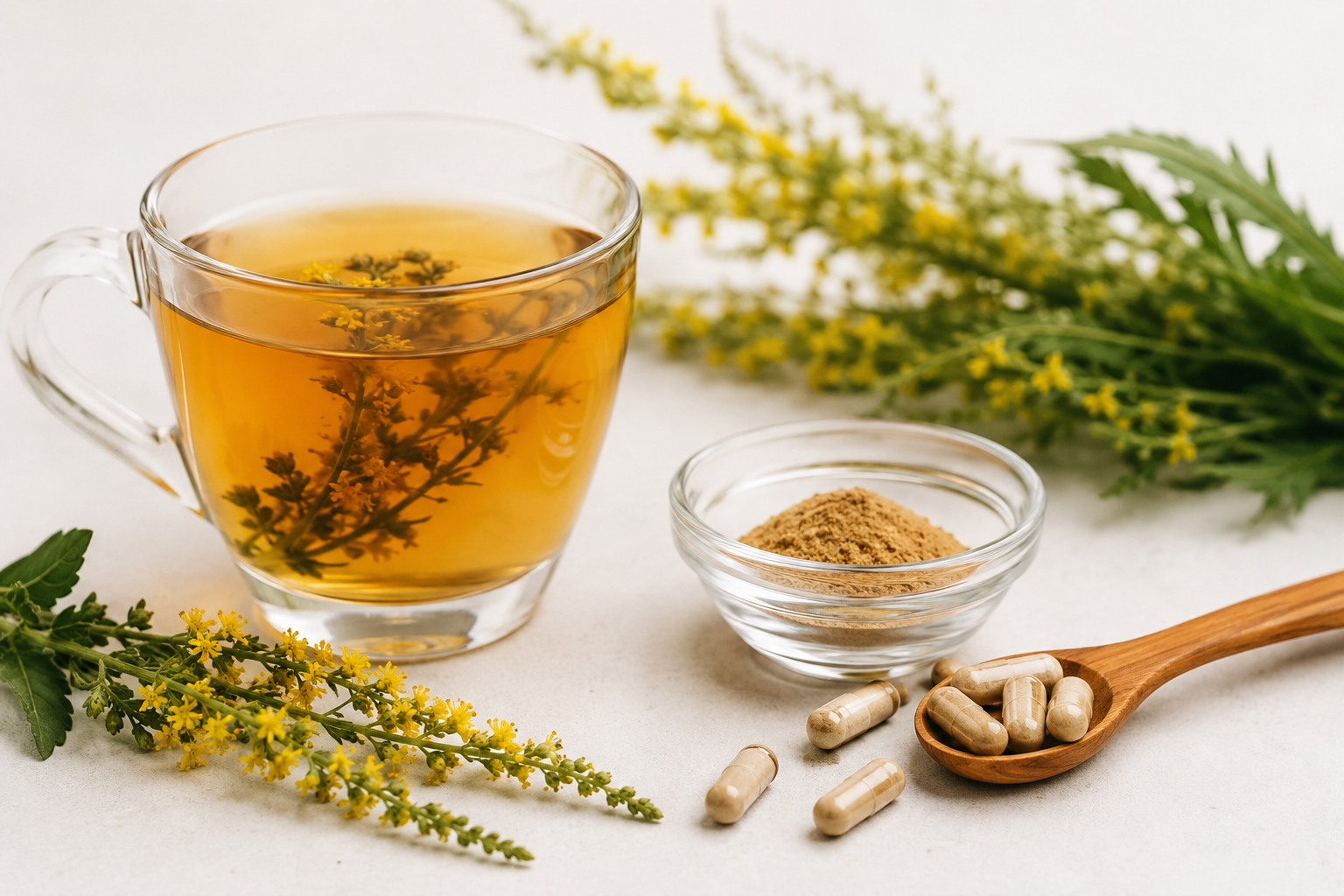
Tea and capsules do not deliver the same physical material in the same way. Tea uses dry herb as the starting material for a water infusion. The spent plant material is normally discarded. A powder capsule contains the ground material itself. An extract capsule contains a processed fraction prepared with a declared or undisclosed solvent.
A mathematical conversion would require more information than most labels provide. You would need the exact species, plant part, moisture basis, particle size, solvent, extraction conditions, extract yield, carrier content, and definition of the ratio.
Even matching herb-equivalent numbers do not make a tea and capsule identical. Herb equivalent describes the amount of starting botanical material associated with an extract. It does not recreate the conditions of a cup prepared with hot water.
HerbEra uses a simple editorial test: if a capsule label does not distinguish powder from extract, the amount cannot be interpreted precisely. A large milligram figure does not repair a missing material description.
Which format is easier to evaluate from the label?
Either format can be transparent. Tea is often easier to understand when it contains one identified cut herb with a clear weight. Capsules can be equally clear when they disclose the ingredient type, actual amount, extraction ratio, herb equivalent, and excipients.
Tea label advantages
Loose tea lets you see the cut plant material. A tea bag can state the dry weight directly. Brewing directions can identify the water volume, temperature, and steeping time.
Visual inspection cannot confirm botanical identity by itself. Finely cut material and blends can also make plant-part verification difficult.
Capsule label advantages
Capsules provide a defined serving count and require no brewing. A detailed Supplement Facts panel can separate powder, extract, and equivalent-herb information.
The closed format means you depend more heavily on the label and manufacturing documentation. The capsule’s appearance cannot show whether it contains plain powder, extract, or a mixture with carriers.
What should both labels say about the plant?
Look for the botanical name Agrimonia eupatoria L. Common names can create confusion with unrelated plants, including hemp agrimony.
The plant part should also appear. Possible descriptions include flowering tops, aerial parts, or herb. These terms overlap but are not always identical. The European pharmacopoeial definition documented for Agrimoniae herba refers to dried flowering tops.
United States dietary supplement labeling rules require the plant part for a botanical dietary ingredient. Tea sold as a conventional food may use a different label structure, so check the full package rather than looking only for a Supplement Facts panel.
Agrimony Tea and Capsule Label Checklist
Use this checklist before comparing milligrams across agrimony products. It separates actual ingredient weight from extract ratios and starting-herb equivalence.
Confirm the species
Look for Agrimonia eupatoria L. rather than relying only on the common name.
Identify the plant part
Check whether the product uses flowering tops, aerial parts, herb, or another specified part.
Name the material type
Determine whether the amount refers to cut herb, powder, dry extract, or herb equivalent.
Check the serving basis
Confirm whether the amount applies to one tea bag, one capsule, or a multi-capsule serving.
Separate extract weight from equivalence
Record the physical extract weight and the declared starting-herb equivalent as different values.
Read the extraction ratio
Find out whether the ratio describes native extract, finished extract, or another convention.
Look for the solvent
Check whether a dry extract label voluntarily identifies water, ethanol, or another extraction liquid.
Review other ingredients
Identify capsule shells, carriers, fillers, flow agents, and ingredients from a blended formula.
Avoid self-calculated conversions
Do not convert tea grams into capsule milligrams unless the manufacturer supplies a clear product-specific basis.
How should tea and capsules be stored?
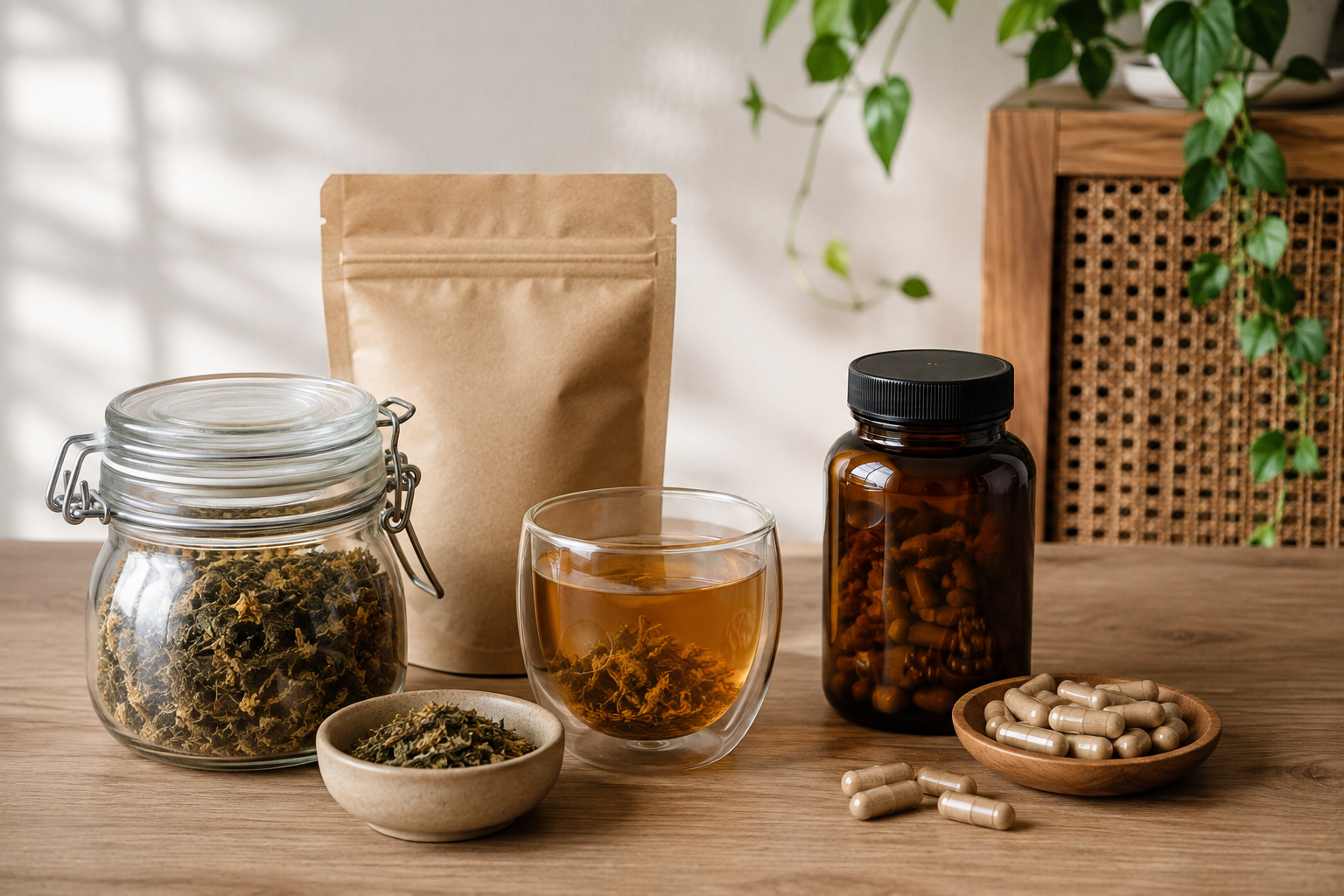
Keep loose tea and tea bags sealed and dry. Protect them from excess moisture, heat, direct light, and strong odors. Follow the printed date and storage instructions.
Capsules also require dry storage. Moisture can affect powder flow, capsule shells, and packaging. Keep them in the original container unless the manufacturer provides different handling directions.
Storage requirements may vary when a capsule contains hygroscopic extracts or specialized excipients. Product-specific instructions take priority over assumptions based on format.
FAQ
Can I compare agrimony tea and capsules by milligrams?
No. First determine whether the number refers to loose herb, powder, dry extract, or herb equivalent.
Is herb powder the same as dry extract?
No. Powder is ground plant material. Dry extract is produced through extraction, separation, and solvent removal.
What does herb equivalent mean?
It is a declared reference to the quantity of starting herb associated with an extract, not necessarily the capsule’s physical fill weight.
Does a 5:1 extract always equal five times the extract weight in dry herb?
Not without context. Confirm the ratio convention, starting material, and whether the amount refers to native or finished extract.
Does 500 mg per serving mean 500 mg in each capsule?
Only if one capsule equals one serving. A two-capsule serving containing 500 mg provides 250 mg per capsule.
Does a tea bag’s net weight equal its agrimony content?
Only when agrimony is the sole ingredient. Blends may include other botanicals or flavoring ingredients.
What botanical name should the label show?
Look for Agrimonia eupatoria L. and a clear statement of the plant part.
Is an extract solvent required on every capsule label?
Requirements vary. FDA does not require the solvent to be identified for every dry extract, but voluntary disclosure improves transparency.
Glossary
Loose herb
Cut or fragmented botanical material supplied for preparation as tea.
Herb powder
Dried plant material ground into fine particles.
Dry extract
An herbal extract from which the extraction solvent has been removed.
Herb equivalent
A declared amount of starting botanical material represented by an extract.
Drug-extract ratio
The relationship between herbal starting material and the resulting extract.
Native extract
Extract material before the addition of carriers or other excipients.
Finished extract
An extract ingredient after any permitted carriers or processing aids have been added.
Carrier
An ingredient added to support drying, stability, handling, or capsule manufacture.
Comminuted herb
Botanical material reduced to smaller pieces without being fully powdered.
Serving size
The number of capsules, tea bags, or measured units defined as one serving on the label.
Conclusion
Compare agrimony tea and capsules by species, plant part, material type, serving basis, extract ratio, and actual ingredient weight. Never assume that loose-herb milligrams, powder milligrams, extract milligrams, and herb-equivalent milligrams describe the same quantity.
Sources Used
- Agrimony botanical identity and official herbal assessment documents, Agrimoniae Herba – ema.europa.eu/en/medicines/herbal/agrimoniae-herba
- Agrimony herbal tea and comminuted herbal substance definitions, European Union Herbal Monograph on Agrimonia eupatoria L., Herba – ema.europa.eu/en/documents/herbal-monograph/final-european-union-herbal-monograph-agrimonia-eupatoria-l-herba-first-version_en.pdf
- Definitions of herbal tea, herbal substance, herbal preparation, and drug-extract ratio, Herbal Tea Preparation Guidance – ema.europa.eu/system/files/documents/regulatory-procedural-guideline/wc500225537_en.pdf
- United States requirements for plant parts, serving sizes, dried extracts, and proprietary blends, Dietary Supplement Labeling Guide Chapter IV – fda.gov/food/dietary-supplements-guidance-documents-regulatory-information/dietary-supplement-labeling-guide-chapter-iv-nutrition-labeling
- General supplement format and ingredient disclosure requirements, Questions and Answers on Dietary Supplements – fda.gov/food/information-consumers-using-dietary-supplements/questions-and-answers-dietary-supplements
- Extraction ratios and equivalent dry or fresh herbal material, Plant Preparations – tga.gov.au/resources/plant-preparations
- Powder, dry extract, ratio, and herbal naming terminology, Complete Approved Herbal Names – tga.gov.au/products/regulations-all-products/ingredients-and-scheduling-medicines-and-chemicals/ingredients-therapeutic-goods/naming-ingredients/ingredient-naming-requirements-and-categorisation/complete-approved-herbal-names